


 by David E. Myers
Hardback: 9781032274980
142 pages
ORDER ONLINE AT ROUTLEDGE: 20% CMS DISCOUNT!
This volume asserts that institutional teaching, study, administration, and performance of music should derive from “essential goodness:” the transcendent value embodied in meaning-making that is manifest through holistic cognitive, creative, kinesthetic, productive, and expressive reality.
The classical music ecosystem suffers from a legacy of survival, rather than flourishing across increasingly diverse audiences among whom personal and shared meaning is the crux of perceived value. Myers calls for a renaissance in professional education and practice that embeds rigorous and disciplined adherence to essential goodness as a non-negotiable premise. Change leadership is essential if classical music and musicians are to offer society the value it deserves through the classical arts, and administrators, boards, funders, and artists must adopt attitudes of service to this greater good in order to invite and lead participatory, co-creative engagement. Through critical analysis of the longstanding status quo, Myers offers powerful suggestions for change beginning in higher education and flowing through applications across society.
Contextualizing music higher education within wider ecosystems of teaching and practice, this book shows how leaders can embrace strategic change as a positive opportunity, and offers new models for addressing contemporary challenges in a mission-driven way, including preparing musicians for careers and engaging communities.
 by Anthony Branker
Hardback: 9781032784809
152 pages
Publish Date: May 6, 2025
PRE-ORDER ONLINE AT ROUTLEDGE: 20% CMS DISCOUNT!
Activating Voices in Jazz History: Students Broadening the Narrative highlights the research of students who have been challenged to assess and interpret evidence found in historical records and engage in field interviews with a diverse representation of jazz artists. This approach serves as a method for co-creating a living history of jazz.
Drawing from the author’s experience in teaching jazz historiography and recognizing that Jazz, African American Music, and the music of the African diaspora offer unique perspectives rooted in culture and community, the book presents a culturally relevant view of the history of jazz. It also proposes a much-needed alternative methodology for teaching this subject. The author reflects on the issues that shape the framing of jazz history and discusses how using a dialogic approach can enable students to engage in critical conversations. The student-led interviews with artists focus on themes such as diversity and inclusion, gender equity, social justice, cultural identity and identification, what the word “jazz” represents, primitivism, reflections on pedagogy, the current state of jazz education, and the development of artistic voice and creative self-expression.
This concise book will be a valuable resource for jazz educators, scholars, students, and enthusiasts alike.
 by Chris Stover
Hardback: 9781032159775
200 pages | 11 B/W Illus.
ORDER ONLINE AT ROUTLEDGE: 20% CMS DISCOUNT!
Reimagining Music Theory: Contexts, Communities, Creativities invites instructors to rethink how we teach music theory, challenging the traditional, classical canon-based pedagogy and offering new and alternative approaches.
The study and teaching of music theory is at a crucial and invigorating crossroads, as conversations are being held about contesting canons, transforming pedagogical practices, and finding meaningful ways to make the field inclusive and diverse in repertoire, methods, and student experiences. This book aims to reimagine music theory as an explicitly and radically dialogic, creative, nimble transdisciplinary space where thinking and acting can be both deep and broad, where pluralities of knowledge systems and ways of doing and being can interact and mutually inform one another, and where teachers learn from students as much as the other way around. Rethinking what counts as music fundamentals, opening music theory to a plurality of global practices, and considering music theory as a creative and community practice are all addressed.
Incorporating interviews with scholar-teachers at the forefront of innovative music theory pedagogy throughout, the book offers music theory professors and instructors frameworks for enacting meaningful change in the music theory classroom.
 by Brian Pertl
Hardback: 9781032131986
128 pages
ORDER ONLINE AT ROUTLEDGE: 20% CMS DISCOUNT!
Radically Responsive Music Schools is a philosophical reimagining of music higher education culture from the ground up, arguing that holistic cultural change is the key factor needed for music schools to prepare 21st-century graduates for contemporary challenges.
The author discusses how university and conservatory music programs can incorporate traits they seek to foster in their students – creativity, innovation, improvisation, and entrepreneurial thinking – into the institutions themselves. Through Deep Listening exercises, thought experiments, and other activities, Pertl provides a detailed scaffolding for creating music school cultures of belonging and collaboration, wellbeing and intention, curiosity and wonder, creativity and improvisation, and playfulness and joy. Unpacking the complexities of transforming institutional culture, this book envisions the modern school of music as agile, collaborative, and socially aware and outlines pathways for leaders to realize this vision.
Radically Responsive Music Schools is an essential resource for college-level music education administrators, professors, students, or staff members interested in how institutional culture can act as a catalyst for radical change in music programs.
 by Michael Stepniak
Paperback: 9781032111520
Hardback: 9781032111513
eBook: 9781003218630
120 pages | 1 B/W Illus.
ORDER ONLINE AT ROUTLEDGE: 20% CMS DISCOUNT!
Today’s higher education music faculty and administrators are faced with extraordinary pressure to adapt, innovate, and change. But what change is most critical to pursue – and how can it be brought about effectively? This concise volume brings together four seasoned thought leaders with distinct voices, each providing a complementary glimpse into how music faculty and administrators can help lead changes that truly matter. Making the case for transformations to better align music training in higher education with our culturally diverse society and the actual marketplace facing graduates, the perspectives collected here provide essential change management leadership strategies for music departments in the 21st century.
Covering topics such as diversity and inclusion, institutional transformation, and preparing students for contemporary music careers, each chapter includes an outline of specific steps that can be taken individually and collectively towards needed change. Illuminating issues and providing practical suggestions, this book will enable both music faculty and administrators to confidently navigate change together with their communities.
 by Edward Sarath
Hardback: 9781032119687
eBook: 9781003222408
132 pages
ORDER ONLINE AT ROUTLEDGE: 20% CMS DISCOUNT!
Music Studies and Its Moment of Truth: Leading Change through America’s Black Music Roots presents a new framework for racial justice discourse in the context of music studies and education. Centering on Black American Music, the book issues challenges to both the conventional music studies paradigm and decades-old reform efforts.
While Black American Music ranks high among America’s contributions to world culture, and offers musicians powerful tools for musical practice and understanding, this musical legacy remains remarkably marginalized even in activist conversations. The author argues that this reflects lingering and unexamined racist patterns that persist even among the most fervent voices for anti-racist interventions, and addresses the need for a higher-order activist framework within music studies.
Delving further into the transformative changes needed to pursue racial justice, the short pieces collected in this book discuss topics including a shift from multicultural ideology to a transcultural model of musical pluralism, analysis of the multi-tiered nature of musical racism, the whitewashing of music studies activism, K-12 music teacher education as the locus for paradigmatic change and the potential for a transformed model of music studies to catalyze an overarching revolution in creativity and consciousness in both education and society at large. Critiquing the failures of progressive reform efforts and conventional reaction, this book argues that major changes are needed to the discourse on racism in music studies, and envisions new paradigms for the future.
 by Ayana O. Smith
Hardback: 9781032113234
eBook: 9781003219385
122 pages | 4 B/W Illus.
ORDER ONLINE AT ROUTLEDGE: 20% CMS DISCOUNT!
Inclusive Music Histories: Leading Change through Research and Pedagogy models effective practices for researchers and instructors striving either to reform music history curricula at large or update individual topics within their classes to be more inclusive.
Confronting racial and other imbalances of Western music history, the author develops four core principles that enable a shift in thinking to create a truly intersectional music history narrative and provides case studies that can be directly applied in the classroom. The book addresses inclusivity issues in the discipline of musicology by outlining imbalances encoded into the canonic repertory, pedagogy, and historiography of the field. This book offers comprehensive teaching tools that instructors can use at all stages of course design, from syllabus writing and lecture planning to discussion techniques, with assignments for each of the subject matter case studies. Inclusive Music Histories enables instructors to go beyond token representation to a more nuanced music history pedagogy.
 by Christopher Jenkins
Hardback: 9781032107837
Paperback: 9781032107868
eBook: 9781003217053
130 pages | 8 B/W Illus.
ORDER ONLINE AT ROUTLEDGE: 20% CMS DISCOUNT!
Assimilation v. Integration in Music Education engages with an existential question for American conservatories and orchestras: What does it mean to diversify Western classical music? Many institutions have focused solely on diversifying the demography of their participants, but without a deeper conversation about structural oppression in classical music, this approach continues to isolate and exclude students of color. Rooted in the author’s experience working with BIPOC (Black, Indigenous, and People of Color) students at a major American conservatory, this book articulates the issues facing minority students in conservatories and schools of music, going beyond recruitment to address the cultural issues that alienate students. The author argues that the issue of diversity should be approached through the lens of aesthetics, and that the performance and pedagogy of Western classical music must change if a more diverse membership is to thrive in this genre.
Reflecting on the author’s experience through the lens of recent critical theory in music education, this volume presents the viewpoints of Black and Latinx music students in their own words. Addressing the impact of racialized aesthetics on the well-being of BIPOC music students, the author shows how students are alienated when attempting to assimilate into conservatory environments and envisions an alternative, integrative approach to conservatory education. Offering a deep dive into the psychological and cultural reasons for the racialization of Western classical music, and potential institutional solutions, this concise book is relevant to performers, students, and institutional leaders.
 by Larry Lee Hensel, Alexander Kahn
Hardback: 9780367434007
Paperback: 9781032518077
eBook: 9781003002956
130 pages | 4 B/W Illus.
ORDER ONLINE AT ROUTLEDGE: 20% CMS DISCOUNT!
Caring for the Whole Musician brings together insights from two expert musicians and educators to consider the relationship between mental and physical health and artistic practice for musicians. Offering a holistic perspective that encompasses the whole being – body, mind, and heart – this book provides emerging musicians with tools, practices, and mindsets to address key challenges throughout their journey.
The first part, Awareness, addresses wellness and embodiment in music, exploring how our bodies are constructed and how the use of our bodies as instruments affects function. Using approaches including Body Mapping and the Alexander Technique, this part helps readers discover adverse habits that interfere with natural movement, and nurture awareness of the body. The second part, Mindfulness, explores how meditative practice can be incorporated into every stage of concert preparation and embedded within the daily life of the musician. Offering mindfulness exercises related to each stage of the music-making process, these chapters provide strategies for readers to enhance their well-being and focus.
Centered in the understanding of the musician as a whole being, this book provides an essential guide to how practices of awareness and mindfulness can allow musicians to better care for themselves and flourish in their artistic careers.
 by Sarah Adams Hoover
Paperback: 9781032006444
Hardback: 9780367408770
eBook: 9780367809669
142 pages | 7 B/W Illus.
ORDER ONLINE AT ROUTLEDGE: 20% CMS DISCOUNT!
This book provides an overview of professional musicians working within the healthcare system and explores programs that bring music into the environment of the hospital. Far from being onstage, musicians in the hospital provide musical engagement for patients and healthcare providers focused on life-and-death issues. Music in healthcare offers a new and growing area for musical careers, distinct from the field of music therapy in which music is engaged to advance defined clinical goals. Rather, this volume considers what happens when musicians interact with the clinical environment as artists, and how musical careers and artistic practices can develop through work in a hospital setting. It outlines the specialized skills and training required to navigate safely and effectively within the healthcare context. The contributors draw on their experiences with collaborations between the performing arts and medicine at Boston University/Boston Medical Center, University of Florida/UF Health Shands Hospital, and the Peabody Institute/Johns Hopkins Medicine. These experiences, as well as the experiences of artists spotlighted throughout the volume, offer stories of thriving artistic practices and collaborations that outline a new field for tomorrow's musical artists.
 by Timothy Cheek
Paperback: 9781032127750
Hardback: 9781032127743
eBook: 9781003226208
124 pages
ORDER ONLINE AT ROUTLEDGE: 20% CMS DISCOUNT!
Drawing on 30 years of teaching experience, author Timothy Cheek demonstrates how a university lyric diction class—traditionally specialized and Eurocentric—can become transformative, through engaging students with other languages and cultures, and promoting diversity, equity, inclusivity, and antiracism.
Raising new possibilities for traditional lyric diction pedagogy, this book explores how to provide students with experiences that speed their growth, help them to see the big picture, spark their curiosity, clarify and expand their digital resources and skills, and set them on a path of international collaboration. Arguing against compartmentalization in voice curricula, and exploring opportunities for creativity, the author provides a guide to new approaches that will aid schools’ decisions about diction curricula in the challenging but promising era of 21st-century pedagogy.
Voice faculty, diction instructors, curriculum committees, graduate students in related fields, and music school administrators should all find this book insightful and thought-provoking as it goes to the heart of issues critical to the long-term development of today’s voice students.
 by James Harrington
Hardback: 9780367421519
151 pages | 2 B/W Illus.
ORDER ONLINE AT ROUTLEDGE: 20% CMS DISCOUNT!
Building a Career in Opera from School to Stage: Operapreneurship provides early-career singers with an overview of the structure of the opera industry and tools for strategically approaching a career within it. Today's voice students leave the conservatory with better training than ever, but often face challenges to managing their own careers after graduation. This book addresses what singers need to know in order to craft a career path in the contemporary landscape of opera.
Readers learn about the opera industry's structure, common pathways and entry points, non-academic training programs, researching and evaluating opportunities, crafting professional documents and media, and what it means to be a professional opera singer. Written by a singer with recent experience in the industry—and particularly the emerging phase—this book is a practical guide for all singers embarking on a career in opera.
The author's website, www.OperaCareers.com, hosts additional resources including databases of training programs, guides and templates for creating professional documents, as well as articles addressing current industry issues and interviews with subject matter experts.
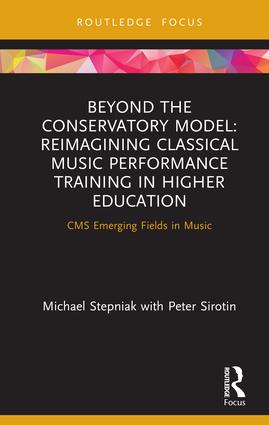 by Michael Stepniak with Peter Sirotin
Hardback: 9780367226930
eBook: 9780429276415
124 pages | 2 B/W Illus.
ORDER ONLINE AT ROUTLEDGE: 20% CMS DISCOUNT!
Amid enormous changes in higher education, audience and music listener preferences, and the relevant career marketplace, music faculty are increasingly aware of the need to reimagine classical music performance training for current and future students. But how can faculty and administrators, under urgent pressure to act, be certain that their changes are effective, strategic, and beneficial for students and institutions? In this provocative yet measured book, Michael Stepniak and Peter Sirotin address these questions with perspectives rooted in extensive experience as musicians, educators, and arts leaders. Building on a multidimensional analysis of core issues and drawing upon interviews with leaders from across the performing arts and higher education music fields, Stepniak and Sirotin scrutinize arguments for and against radical change, illuminating areas of unavoidable challenge as well as areas of possibility and hope. An essential read for education leaders contemplating how classical music can continue to thrive within American higher education.
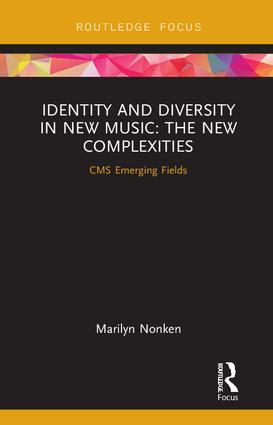 by Marilyn Nonken
Hardback: 9781138388482
eBook: 9780429425516
92 pages
ORDER ONLINE AT ROUTLEDGE: 20% CMS DISCOUNT!
Identity and Diversity in New Music: The New Complexities aims to enrich the discussion of how musicians and educators can best engage with audiences, by addressing issues of diversity and identity that have played a vital role in the reception of new music, but have been little-considered to date.
Marilyn Nonken offers an innovative theoretical approach that considers how the environments surrounding new music performances influence listeners’ experiences, drawing on work in ecological psychology. Using four case studies of influential new music ensembles from across the twentieth century, she considers how diversity arises in the musical environment, its impact on artists and creativity, and the events and engagement it makes possible. Ultimately, she connects theory to practice with suggestions for how musicians and educators can make innovative music environments inclusive.